

Professional development reporting is an important responsibility for school districts, but it involves more than tracking which teachers attended a workshop or completed a training session.
District administrators must maintain accurate professional learning records, verify participation, track completed hours, and access documentation when needed for educator license renewal or other reporting requirements.
For HR directors, curriculum leaders, and professional development coordinators, this can become time-consuming when information is scattered across spreadsheets, attendance sheets, emails, and multiple departments.
Two responsibilities are especially important to professional development reporting: PD documentation and compliance reporting.
Although these processes work together, they serve different purposes. Understanding the difference can help districts improve recordkeeping, reduce administrative work, and stay better prepared when reporting deadlines arrive.
What Is Professional Development Reporting for Compliance?
Professional development reporting is the process of organizing, reviewing, and presenting information about educators’ professional learning activities.
School districts use these reports to monitor participation, track completed training hours, review professional learning records, and support administrative or compliance-related responsibilities.
Effective professional development reporting depends on two connected processes:
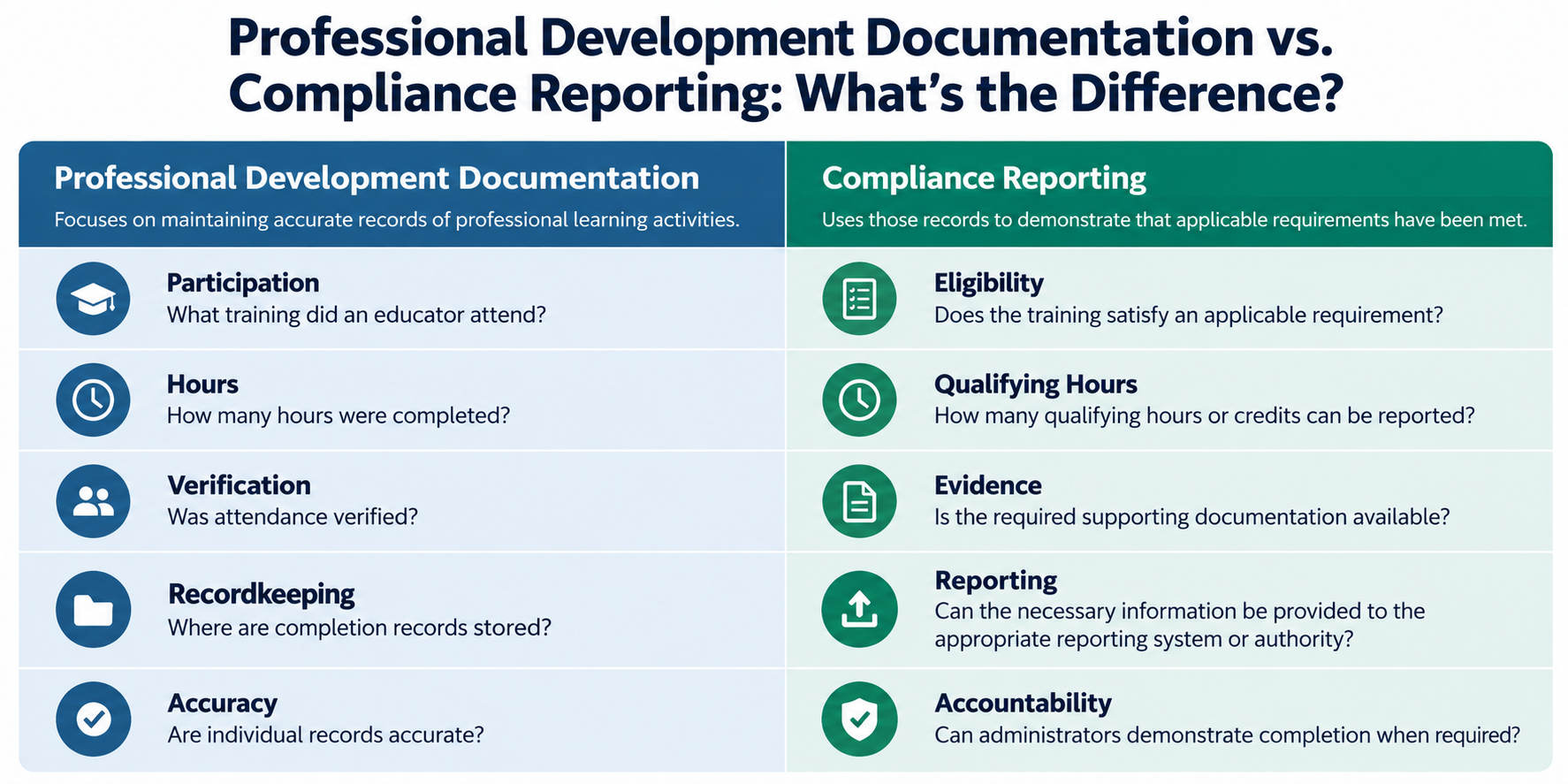
- PD documentation: Collecting and maintaining accurate records of professional learning activities.
- Compliance reporting: Using relevant records to demonstrate progress toward or fulfillment of applicable requirements.
Documentation provides the information. Reporting puts that information to use.
However, maintaining an internal PD record does not automatically mean an educator has satisfied a particular state requirement.
What Is Professional Development Compliance Reporting?
While documentation focuses on maintaining accurate records, compliance reporting involves using those records to demonstrate that applicable requirements have been met.
Depending on the state, educator credential, and type of professional development, districts may need to support reporting related to license renewal, continuing education, or other training requirements.
For example:
- Illinois: Educators holding a Professional Educator License generally complete 120 professional development hours during a five-year renewal cycle, subject to applicable rules and exemptions.
- Pennsylvania: Act 48 generally requires educators to complete 180 hours of continuing professional education, or an equivalent combination of credits and hours, within a five-year period.
- Michigan: Educator certificate renewal may involve State Continuing Education Clock Hours (SCECHs), District Provided Professional Development (DPPD), or qualifying college coursework, depending on the certificate and renewal pathway.
These examples illustrate why accurate documentation matters. However, reporting responsibilities and official record systems vary by state.
A district’s internal PD records can support compliance-related work, but maintaining those records does not automatically satisfy every state reporting or educator license renewal requirement.
Professional development reporting becomes more complex when districts must distinguish completed training from qualifying activities.
Why Disconnected PD Records Create Administrative Challenges
Many school districts manage professional development across several departments.
Curriculum teams may coordinate training opportunities, HR departments may maintain educator records, and professional development coordinators may handle registration, attendance, and completion verification.
When these responsibilities are managed through disconnected systems, administrators may encounter several challenges.
Disconnected records can make professional development reporting more time-consuming than necessary.
1. Inconsistent Records Across Departments
Different departments may maintain separate records of the same professional development activities.
Without consistent documentation practices, administrators may need to compare spreadsheets, emails, and attendance reports to confirm whether a training was completed.
2. Time-Consuming Attendance Verification
Registering for professional development does not necessarily mean an educator attended or completed the activity.
Administrators may need to review sign-in sheets, verify participation, and update records before completion can be confirmed.
3. Difficulty Accessing Historical PD Records
When educators change schools, departments, or positions, historical professional development records may become harder to locate.
Maintaining accessible records helps districts respond to documentation requests and review previously completed training.
4. Last-Minute Reporting Preparation
When records are not consistently maintained, reporting periods can require additional administrative work.
Instead of reviewing information that is already organized, staff may spend time collecting missing documents, reconciling records, and confirming completion details.
How to Simplify Professional Development Reporting
Improving professional development documentation does not necessarily require a complicated technology system.
Districts can begin by establishing a few consistent practices.
- Standardize Professional Development Records – Identify the information that should be collected for every PD activity. Using consistent fields for attendance, hours, completion, and validation can help reduce discrepancies between departments.
- Establish Clear Validation Procedures – Determine who is responsible for confirming attendance and approving completed activities. Clear validation procedures help distinguish between educators who registered for training and those who actually completed it. Consistent validation also improves the accuracy of professional development reporting.
- Centralize Access to PD Information – When authorized administrators can access professional development information in one location, they spend less time searching across disconnected records.Centralized information can also improve coordination between HR, curriculum, and professional learning teams.
- Review Records Throughout the School Year – Rather than waiting until reporting deadlines approach, districts can periodically review pending validations, incomplete records, and outstanding documentation. Regular reviews can make reporting preparation more manageable.
How Kalpa Supports Professional Development Reporting
Kalpa Solutions provides a centralized platform for managing educator professional development.
Instead of relying on disconnected spreadsheets and manual processes, districts can use Kalpa to organize PD activities, manage registration, track attendance, validate completion, and access reporting information.
With Kalpa, administrators can:
- Maintain professional development records in a centralized system
- Manage course registration and attendance
- Review and validate completed professional development
- Track professional development hours and activities
- Access administrative reports to support district recordkeeping and oversight
Kalpa is designed to make everyday professional development administration more manageable without requiring districts to adopt an unnecessarily complicated system.
Centralized records can make professional development reporting easier for authorized district administrators.
While Kalpa can help organize information used in compliance-related workflows, districts remain responsible for confirming applicable state requirements and completing any required reporting through official state systems.
Better Documentation Makes Reporting Easier
Professional development documentation and compliance reporting are different responsibilities, but both depend on accurate, accessible information.
When districts maintain consistent records, establish clear validation processes, and give administrators better visibility into professional learning activities, they can reduce the manual work involved in preparing reports.
The goal is not simply to collect more information. It’s to make the information districts already need easier to manage and use.
Professional learning should support educator growth, not create unnecessary administrative headaches.
Professional Learning, Without the Compliance Headaches.
Kalpa helps school districts simplify professional development documentation, attendance validation, and reporting workflows through a practical, centralized solution.
Interested in seeing how Kalpa could support your district? Schedule a Demo